Thinking Strategically
Oligopoly is another type of imperfectly competitive market, where a small number of firms dominate. Characteristics of an oligopoly are:
- Natural or legal barriers of entry
- Small number of firms interdependent of each other, with temptation to cooperate in order to increase their joint profit
- Products are either differentiated or homogenous
- Engage in non-price competition, g. marketing, advertising
- Engage in infrequent price wars
- Inflexible prices that rarely change and changes are adopted by all firms
- Economic profit exists in the long run
Game Theory
Game theory is a tool for studying strategic behaviour, which is behaviour that takes into account the expected behaviour of others and the mutual recognition of interdependence. The basic elements of a game are the:
- Players
- Strategies available to each player
- Payoff for each possible combination of strategies
Strategies of a Game
- Dominant strategy: one that yields a player a higher payoff no matter what the other players in the game choose
- Dominated strategy: any other strategy available to a player who has a dominant strategy
- Nash Equilibrium: a set of strategies, one for each player, in which each player’s strategy is the best choice given the other player’s strategy
Prisoner’s Dilemma
The prisoner’s dilemma is a game in which each player has a dominant strategy, and when each plays their dominant strategy; the resulting payoffs are smaller than if each had played a dominated strategy.
E.g. Horace and Jasper are two prisoners in prison for a bank robbery they did in fact commit. However, the prosecutor can only convict one of them. Each is told that if they confess, they will go free and the other would receive a 20-year sentence. However, if both confess then they will receive 5 years each and if neither confesses then they will receive 1 year each.
Both prisoners have a dominant strategy:
- Horace should confess because if he doesn’t and Jasper confesses, then he will get 20 instead of the If Jasper doesn’t confess, then Horace goes free. So either way the payoff is better than the other choice
- Same for Jasper
- Nash equilibrium established, since each player’s strategy is their best, no matter what
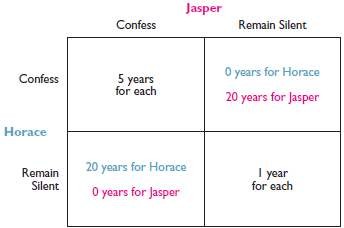
When both prisoners play their dominant strategy, i.e. confess, they will get 5 years each. However, if both played their dominated strategy, i.e. deny, then they will get 1 year each only.
Prisoner’s Dilemma and Imperfectly Competitive Markets
This form of prisoner’s dilemma is often seen in oligopoly markets, where competing with other firms may be the dominant strategy but yields less profit for both firms. Jasper and Horace can collude to both deny, which benefits both of them more. Similarly, firms in oligopoly can collude to fix price instead of trying to cut prices and compete in order for a greater profit for all firms
Cartels
A cartel is a group of firms that conspires to coordinate production and pricing decisions in an industry for the purpose of earning an economic profit. However, cartels are often unstable:
- Incentive to cheat by selling cheaper/more than the agreed price/quantity. This result in a repeated prisoner’s dilemma and each player will use a tit-for-tat strategy, where both players start off cooperating, but one cheats and the other will continue to copy. This continues until economic profit becomes zero.
- Individual firms have different cost and demand curves so it’s hard to agree on one price
Large number of firms, g. OPEC, hard to get everyone to agree
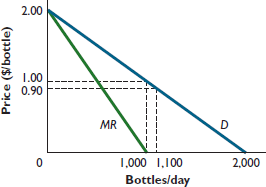
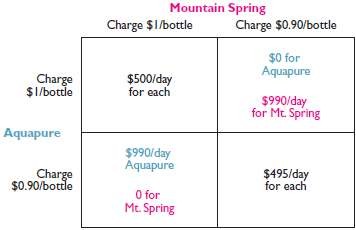
By colluding, both firms capture half the market (500 out of 1000) and make an economic profit of
$500, as given by the profit maximising condition where MR equals MC (marginal cost is zero). However, if firm X decides to cut prices to $0.9 per bottle, then it will capture the entire market demand of 1100 and make an economic profit of $990. Now firm Y must also match this new price, otherwise it will make zero profit. By matching the price, both again split the market but now only make $495 economic profit, less than the $500 before. This cycle will continue until there is no more economic profit for either firm.