How could a manager apply the concept of management by objectives (MBO) to motivate employees at work? Explain.
MBO as a Significant Tool of Motivation The term 'management by objectives' (MBO) was first coined by Peter Drucker in 1954, Drucker fried to attach MBO level to result-oriented evaluations. He proposed MBO as a means of using goals to motivate people rather than to control them. Management by objectives can simply be defined as a program that encompasses specific goals, anticipatively set, for an explicit time period, with feedback on goal progress.
MBO provides specific objectives for each succeeding level (i.e., divisional, departmental, individual in the organization). In other words, MBO is a process by which objectives cascade down through the organization as depicted in the following figure.
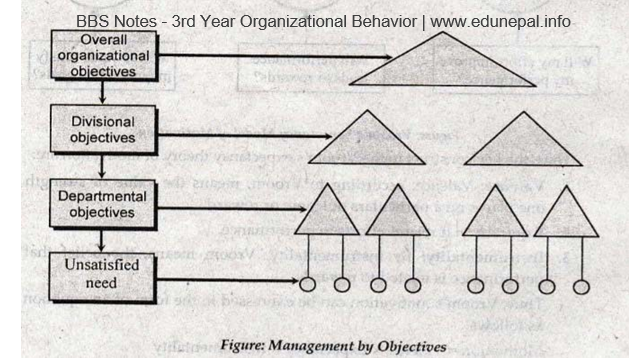
An MBO program or process consists of four common ingredients are explained below.
- Specificity: The objectives in MBO should be clear and precise that can be measured and evaluated.To state a desire to cut costs, for example, may not be enough. 'Instead, to cut costs by 5 per cent will be more clear, exact and measurable objective
- Participative decisions/Objectives: An MBO goals are not imposed on people. The superior and subordinates jointly set objectives to be attained.
- Explicit time: Each objective is to be completed within a specific time period, be it three months, six months or a year.
- Performance feedback: The final ingredient in an MBO programme is feedback. It includes -continuous and systematic measurement and review of performance. Based on these, corrective actions are taken to achieve the planned objectives.